

Table of Contents
- Marvel Legends vs Black Series: How the Two Lines Compare
- Marvel Legends Figure Scale and Black Series Figure Scale
- Sculpt, Paint Detail and Comic-Inspired Design
- Articulation, Poseability and Range of Motion
- Character Selection, Franchise Coverage and Accessories
- Marvel Legends Figures Value and Rarest Black Series Figures
- Durability, Display and the Costs Beyond Retail Price
- Which Line Should You Collect?
- Frequently Asked Questions
Last Updated: October 7, 2026
Marvel Legends vs Black Series: How the Two Lines Compare
Ask any collector which six-inch line to start with and you will get a strong opinion within seconds. The marvel legends vs black series action figures question has divided shelves for years, and both lines are excellent at different things. This guide from AJ Toys & Books breaks down scale, sculpt, articulation, character selection and long-term cost so you can decide where your money goes.
Here is the part most comparison articles skip: these are two different products wearing similar packaging. Marvel Legends is Hasbro's Marvel Comics and Marvel Studios line, built around comic-inspired design and a deep bench of heroes and villains. The Black Series is Hasbro's Star Wars collector line, built around screen-accurate design and a tighter roster. Same manufacturer, different design brief.

| Feature | Marvel Legends | Black Series |
|---|---|---|
| Typical scale | Six-inch scale | Six-inch scale |
| Design focus | Comic-inspired design | Screen-accurate design |
| Character pool | Very wide, Marvel-wide | Star Wars only |
| Articulation | High, varies by release | High, varies by release |
| Build-a-figure | Common in waves | Occasional releases |
| Accessories | Alternate hands, effects | Alternate hands, weapons |
Marvel Legends Figure Scale and Black Series Figure Scale
Both lines sit at the six-inch scale, so they display well together on the same shelf, a fact that surprises many new collectors who assume the ranges are incompatible.
In practice, scale consistency within each line matters more than scale between lines. Marvel Legends figure scale is designed so Spider-Man stands shorter than Thor, reflecting the characters themselves. Black Series figure scale follows the same logic, so a Jawa sits well below a Wookiee. Mix the two lines and expect some height mismatch, but nothing that ruins a display.
The practical takeaway: buy for the character you want, not the number on the box.
Sculpt, Paint Detail and Comic-Inspired Design
Sculpt and paint are where the two lines diverge most clearly. Marvel Legends leans into comic-inspired design, with exaggerated musculature, bold colours and paint detail that mimics printed comic art. Black Series leans into screen-accurate design, with softer fabric folds, muted tones and head sculpts modelled on specific actors.
What most guides miss is that paint application varies release by release, not line by line. A flagship Marvel Legends release can carry sharper paint detail than a minor Black Series figure, and the reverse happens too. Judge each figure on its own merits rather than assuming one line paints better.
Articulation, Poseability and Range of Motion
Articulation is close to a tie. Both lines use similar joint engineering: ball joints at the shoulders and hips, hinges at the elbows and knees, and a waist or ab crunch.
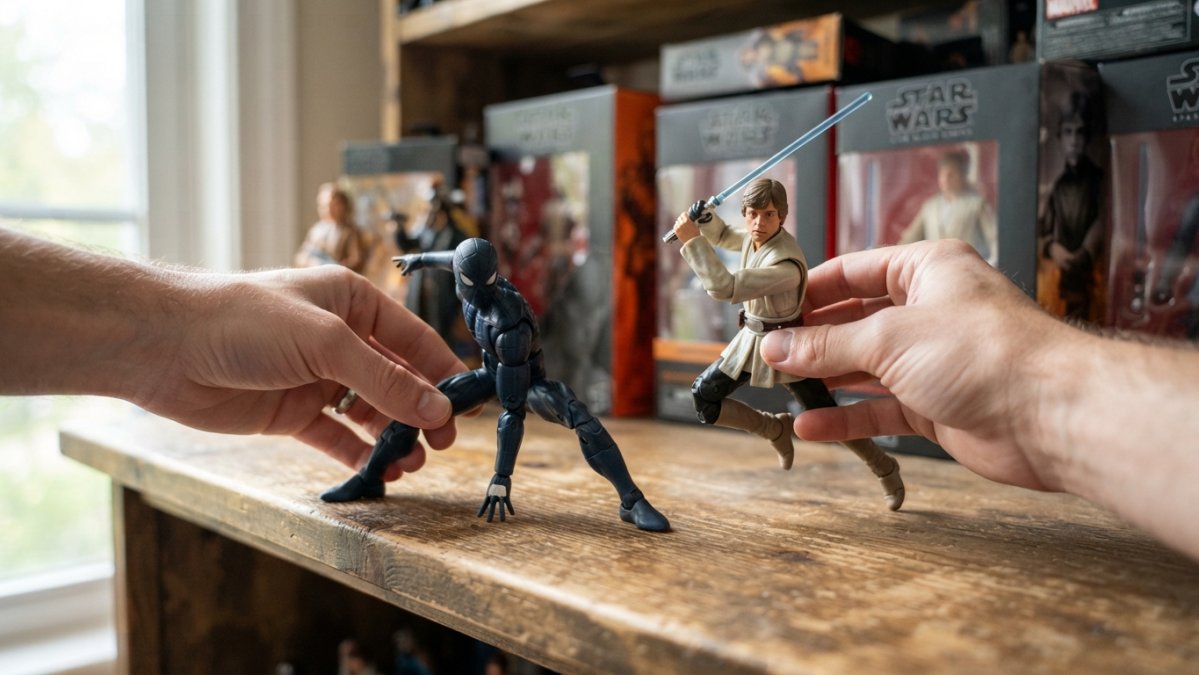
Where they differ is in what the articulation is asked to do. Marvel Legends figures are often posed mid-leap or mid-punch, so joints are engineered for dramatic, comic-book poses.
If poseability is your priority, both lines deliver. If you want a figure frozen in a specific film moment, Black Series usually gets you closer out of the box.
Character Selection, Franchise Coverage and Accessories
Character selection is the clearest dividing line.
Accessories follow the same pattern. Marvel Legends releases commonly include alternate hands and effect pieces. Black Series releases typically include alternate hands and weapons, and occasionally a removable helmet or soft-goods cape.
A good example of how Black Series handles accessories is the Star Wars The Black Series Ahsoka Tano (Padawan) 6-Inch Action Figure, which includes two green lightsabers and features exceptional articulation.
Build-a-figure components are another difference worth knowing. Marvel Legends waves frequently split a large bonus figure across the set, so buying the full wave completes it. Black Series uses this approach far less often.
Marvel Legends Figures Value and Rarest Black Series Figures
Value in both lines is driven by supply, not age, and that principle explains almost every secondary-market price you will see.
Here is the mechanism most guides skip. Hasbro produces mainline waves in large runs that stay in distribution for roughly a year, then taper off.
What actually drives secondary-market prices
- Exclusives. Figures tied to a specific retailer or event are produced in smaller numbers and are the most common source of high secondary prices in both lines. If a figure was never available through general retail, expect a premium.
- Fan-favourite characters. A popular character from a well-loved film or comic run will always outsell a minor one, regardless of sculpt quality.
- Build-a-figure completion. Marvel Legends waves frequently split a large bonus figure across the set. If the bonus figure is desirable, demand for the individual wave figures rises, because collectors need the whole wave to complete it. This is a Marvel Legends-specific value driver that Black Series rarely replicates.
- Reissues. Both lines re-release sought-after figures, sometimes with updated paint or articulation. A reissue resets the secondary price of the original, often sharply. This is the single biggest risk for anyone buying at a peak.
The costs beyond retail price
The sticker price is only the entry point. A realistic ownership budget includes:
Star Wars The Black Series Ahsoka Tano (Padawan) 6-Inch Action Figure →
- Secondary-market premiums when a figure is out of distribution
- Shipping, which is often the deciding factor when buying single figures online
- Protective cases or display stands, especially for boxed collectors
- Shelving or a display cabinet, because six-inch scale figures take up real room in numbers
- Storage for packaging if you keep figures boxed
- Replacement figures for ones you damage while posing
Collectors underestimate the secondary-market line item most. If you chase a specific character, set a ceiling before you start and treat anything above it as a pass.
The practical approach is to buy what you actually want to display and treat rarity as a bonus rather than a strategy. If a figure is genuinely hard to find, expect to pay above retail on the secondary market and budget for it before you start.
Durability, Display and the Costs Beyond Retail Price
Durability is where collector opinion is loudest and evidence is thinnest. Both lines use similar joint engineering and plastics, and both have improved over recent years.
Where figures actually fail
- Stiff joints out of the box. The most common issue on both lines. A joint that will not move is usually paint or mould flash binding it, not a design fault. Warming the figure gently before forcing the joint is the standard fix, and forcing it cold is the most common cause of breakage.
- Paint rub at articulation points. Paint applied across a joint can flake or transfer when the joint moves. This shows up most on shoulders, elbows and knees, and it is a cosmetic issue rather than a structural one.
- Face and head sculpt quality control. The face is where quality control slips most often on both lines, and it is the part you look at every day on the shelf. Check the head sculpt first on any figure you buy in person.
- Accessory fragility. Thin weapons, effect pieces and soft-goods capes are the parts most likely to be damaged in handling or storage, not the figure itself.
Figures stored loose in a box fare worse than figures on a shelf or in a case, because loose storage puts pressure on joints and accessories over time. If you keep figures boxed, store them upright and avoid stacking.
Display and compatibility
Both lines sit at the six-inch scale, so they display together on the same shelf, but scale consistency within each line matters more than scale between lines.
Practical display points worth planning for:
- Shelf depth. Six-inch scale figures need more depth than most people expect once they are posed. A figure mid-swing or mid-leap takes up considerably more room than one standing straight.
- Stands. Dynamic poses usually need a stand, and stands are not included with most releases. Budget for them if you pose figures rather than standing them.
- Mixing lines. The two lines display well together at a distance, but up close the design language differs. Comic-inspired Marvel Legends figures and screen-accurate Black Series figures read as different styles on the same shelf, which is a display choice rather than a problem.
- Boxed versus open. Decide early whether you are an opener or a boxed collector, because it changes how much space you need. Boxed collections take up several times the shelf space of open ones.
The costs beyond retail price
Costs beyond retail price add up quickly:
- Protective cases or display stands
- Shelving or a display cabinet
- Shipping when buying from online retailers
- Storage for packaging if you keep it
- Replacement parts or figures for ones you damage
Budget for these before you commit to a line, not after. The figures are the visible cost; the display and storage around them is what collectors forget.
Which Line Should You Collect?
The answer depends on what you want on the shelf. For the widest character selection and comic-inspired design, Marvel Legends is the better fit.
Here is how we would decide:
- For Marvel fans: Marvel Legends, for franchise coverage and character variety
- For Star Wars fans: Black Series, for screen-accurate sculpt and paint detail
- For display-first collectors: Either line, judged figure by figure
- For new collectors: Start with one line, not both, to keep costs manageable
Both lines are made by Hasbro, both sit at the six-inch scale, and both reward careful buying over impulse buying. Pick the franchise you love, buy the characters you actually want, and let the shelf grow.
At AJ Toys & Books, we stock collectible figures and can talk you through what is worth adding next, whether you are buying for yourself or for a gift.
Choosing between two strong lines is harder than picking a winner, because neither is actually worse. The real challenge is knowing which characters you will still want on your shelf in five years.
Frequently Asked Questions
Are Marvel Legends and Black Series figures the same scale?
Both lines sit at the six-inch scale, so a standard figure from either stands roughly 15cm tall. That said, scale consistency varies by character: a large alien or armoured villain may be taller than a standard human figure in the same line. If you display the two lines together, check individual heights rather than assuming every figure matches. Marvel Legends figure scale and Black Series figure scale are close enough that mixing them on one shelf looks natural.
Which has better articulation: Marvel Legends or Black Series?
It depends on the specific release rather than the line as a whole. Both use ball joints, hinges and swivel cuts, and modern figures from either range usually manage a deep crouch, an overhead swing and a two-handed weapon grip. Black Series figures often hide joints under sculpted armour or fabric, which can slightly restrict range of motion. Marvel Legends figures tend to expose pin joints more openly, which gives a wider pose range but a less clean silhouette.
Are Marvel Legends figures worth anything?
Most Marvel Legends figures sell for close to retail on the secondary market, so Marvel Legends figures value depends heavily on the character and how long ago it was released. Popular comic-based characters and figures that complete a build-a-figure tend to hold value better than movie tie-ins, which are often reissued. Sealed figures with intact packaging consistently sell for more than opened ones, so keep boxes if resale matters to you.
What is the rarest Black Series figure?
The rarest Black Series figures are usually early convention exclusives and short-run store exclusives from the line's first few years, produced in far smaller numbers than mainline releases. Availability, not age, drives rarity: a figure that was never reissued and had limited retail distribution is harder to find than an older figure that saw multiple runs. When hunting the rarest Black Series figures, check whether a reissue exists before paying a premium.